
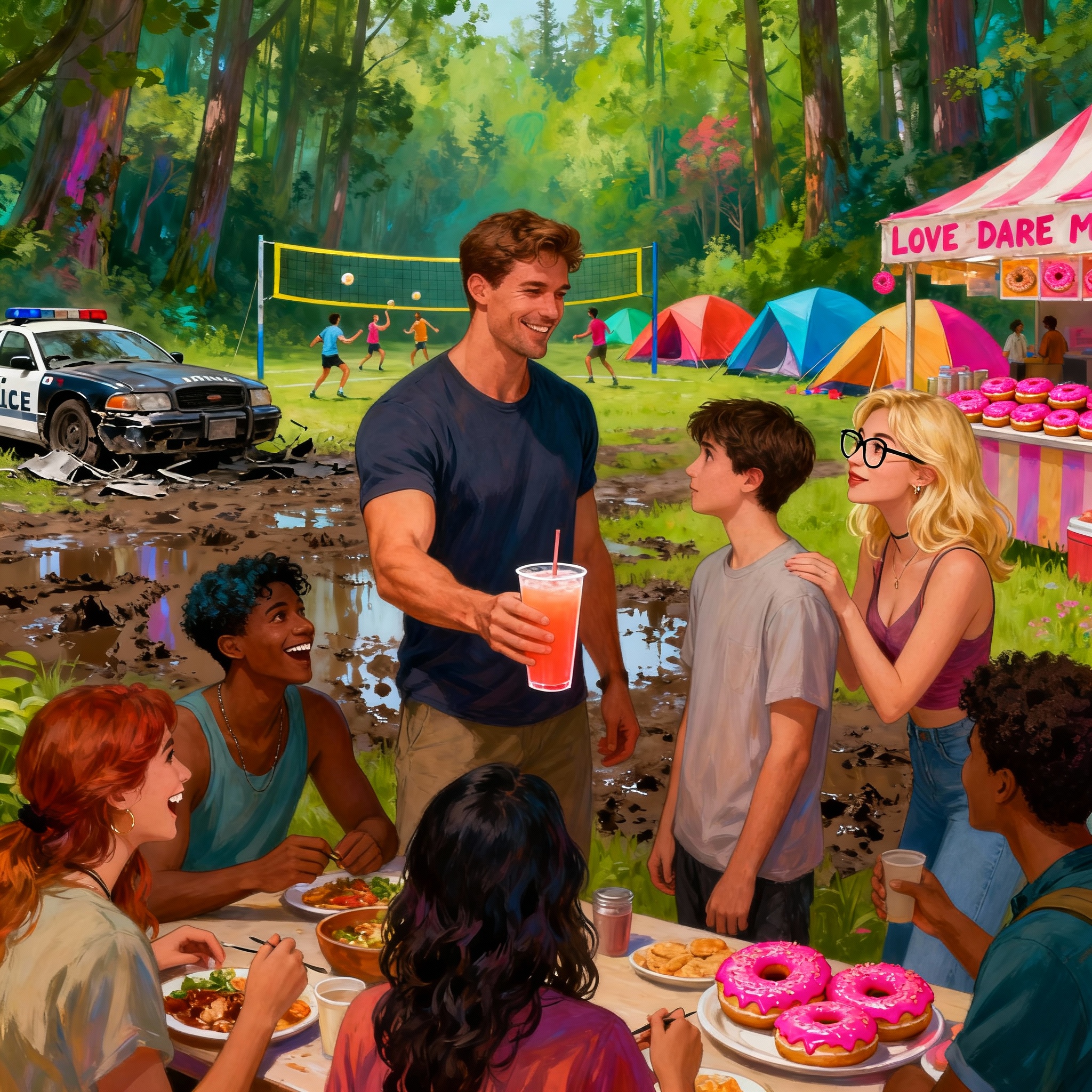
In this dream, I found myself nearby my childhood town but in an unfamiliar area that drew me in—I wanted to explore it—shifting into an unexpectedly welcoming camp community where they treated me as if I belonged, even though I felt like an outsider. I started out near my old house, but the setting blurred into the more rural, unincorporated outskirts of town, the kind of area that lies outside any formal city limits or local government structure. I was driving a car when I suddenly decided I wanted to turn down a particular road, so I stopped, got out of the car, and began controlling it remotely, almost like a video game vehicle instead of something I was physically inside. As I steered it from a distance, the car ended up in a dramatic accident with a police cruiser, drawing attention because there was no driver visible in the seat, only a mysteriously crashed vehicle. The officer wanted to know how this could have happened, and I quietly slipped away from the scene, knowing I was responsible yet determined not to get caught. I sensed that the police were going to investigate and eventually track down whoever orchestrated this driverless crash, and I felt that I was in serious trouble. As I walked briskly away, they towed the car and began searching the area, discussing suspects and narrowing in on the idea that some kid who plays video games must have been controlling the car—essentially describing what I actually did. I kept moving, carrying the tension of secret guilt while refusing to turn back or confess, driven by the need to get away and somehow make it home. My escape route led into a forested area where the ground was wet, soft, and mushy, but I pushed on, focused on getting through no matter how uncomfortable it felt underfoot. Emerging from the trees, I stumbled onto what felt like a hidden summer camp, bustling with activity and filled with hundreds of people around my age, scattered across the grounds. Some were playing volleyball, others mingling, and there was even a kind of market stand that looked like it belonged to a weight-loss or “fat camp,” with low-calorie treats and foods clearly aimed at people trying to slim down. At the camp market, I noticed trays of low-calorie donuts that looked surprisingly appealing: regular donuts glazed and topped with bright pink icing that caught my eye. I recognized that this place seemed designed for heavier people focused on losing weight, and that I, being already skinny, did not really fit the intended profile of the campers. I studied the donuts, thinking how good they looked and how I could probably eat a lot without gaining weight, but my allergies made me hesitate, adding another layer of caution to my sense of not quite belonging. Ultimately, I decided not to indulge and turned away, continuing to wander through the camp while some people glanced at me curiously and others offered friendly, open energy. As I reached the edge of the camp, a very fit, friendly man called out to me with a warm “Hey,” stopping me just as I was about to leave. He introduced himself indirectly by his role and energy, and I quickly learned he was the director of the entire camp and campground, someone who carried authority but came across as kind and approachable. When he asked my name, I gave my real name, Rob, and shook his hand, letting myself be seen honestly even though I had just run from the accident. He assumed I was a new camper and casually asked where my sleeping bag was, and I improvised that I forgot it, expecting this would be temporary, but he reassured me not to worry and invited me to stay for dinner anyway. I noticed that Dan seemed like a very busy, energetic businessman, and I asked him what he did besides running the camp, curious about his life outside this place. He told me that he owned a smoothie shop, which sparked my genuine interest because the idea of a smoothie business already appeals to me in waking life. When I asked how the shop was doing, he said it was doing reasonably well, and then enthusiastically said, “Come on, I want to show you something,” leading me over to a station lined with around forty different smoothies. He poured me a small sample, a warm peach–ginger blend that felt anti-inflammatory and appetite-curbing, and I found it really good, prompting him to make me a full cup that still “hit the spot” even though it was not cold. There were people everywhere at this camp, but the atmosphere around me was warm and social, and Dan stayed close, asking what I was doing next and easily accepting my answer that I was about to have dinner with him. An older woman, who might have been his wife or a senior staff member, served plates of food, and I received a dish of cream of chicken with vegetables that looked comforting and substantial. As soon as the plate hit my hands, I asked whether the cream was dairy-based because of my allergies, showing that I was both cautious and self-protective around food in unfamiliar environments. Dan did not know the answer since the camp functioned almost like a communal kitchen where campers cooked and shared meals, so he simply advised me not to eat it until they could confirm, and others went off to track down the cook, who happened to be out playing volleyball. I sat at a corner, bench-style table with about four people, soaking in the sense of community and watching interactions unfold around me. Among them was a blonde, nerdy-looking, heavyset woman with glasses who seemed particularly intrigued by my presence, studying me with a kind of open curiosity. At some point in the conversation, she playfully asked who she was supposed to sleep with that night, putting the question out in the open where the camp director heard it. He immediately deflected, saying he was not supposed to know anything about that, maintaining his role as responsible authority while leaving room for the social undercurrents. I responded by making a light joke that she could just pick someone and whisper it in their ear, turning the tension into something more playful and less awkward. She responded with a bolder twist, saying she might have to do that not later but right there at dinner, and as she said it she looked directly at me. In that moment, I recognized her gaze and tone as a direct invitation, an opening into intimacy or connection, all the more striking because I technically did not have a sleeping bag or an official place in the camp at all. The dream left me in that charged space: a stranger who ran from a crime in an unincorporated nowhere, now unexpectedly welcomed, fed, and flirted with in a community that did not know my past but instantly offered me belonging.
Dreams often encapsulate various elements of our subconscious thoughts, emotions, and experiences. Your dream appears rich with themes of belonging, guilt, exploration, and self-acceptance. Let's break down the different segments to interpret their potential meanings:
Childhood Town and Unfamiliar Territory: The dream begins near your childhood town, symbolizing familiarity and comfort, yet you are drawn to explore an unfamiliar area. This suggests a part of you is yearning to explore new territories in life, ones that deviate from your established norms or comfort zones. There's a desire to expand beyond the known and comfortable past.
Remote Control of Car and Accident: Controlling the car remotely signifies a sense of detachment or desire to manage life situations from a distance. The crash with a police cruiser and your subsequent guilt indicate feelings of responsibility that you're avoiding or feel guilty about. The police investigation could symbolize an internal conflict – your conscience grappling with unresolved issues or mistakes.
Escape and Secret Guilt: The act of swiftly escaping the scene mirrors a subconscious urge to evade responsibility or face consequences. This might be indicative of real-life situations where you're avoiding confrontation or accountability.
The Forest Path: The wet, mushy forest path represents traversing through uncomfortable or uncertain phases in life. However, your determination to push through may signify resilience and an unwillingness to be bogged down by obstacles.
Hidden Summer Camp and Community Acceptance: Stumbling upon the summer camp suggests a discovery of a new, welcoming social space where you feel unexpected acceptance despite differences. This could reflect a deep-seated wish for belonging and community, a desire to be accepted for who you are, regardless of past actions or external appearances.
Feeling of Not Fitting In: Your awareness of not being the stereotypical camper reflects insecurities or a feeling of not fitting into particular societal norms or expectations. Yet, your presence in the dream shows an undercurrent of longing to be part of a community that might not be your usual crowd but offers acceptance and warmth.
Encounters with Dan and the Smoothie Shop: The character of Dan, who is kind yet authoritative, represents an ideal support figure in your life. His ownership of a smoothie shop connects to practical aspirations or interests you hold dear in real life. Sampling the smoothies serves as a metaphor for trying new experiences in life and embracing what nourishes or excites you.
: The interaction exemplifies curiosity and possible romantic interest or personal connection within the space of community and acceptance. Your playful exchange indicates a need to lighten situations and create bonds, even as an outsider. This could reflect a wish to be seen and acknowledged in new environments, despite your feelings of detachment.
Underlying Themes:
Overall, your dream encapsulates a journey of self-discovery, acceptance, and the desire to reconcile your inner conflicts while exploring new facets of yourself in unfamiliar territories. It's an invitation to reflect on where you feel isolated and where you yearn for community and acceptance, urging you to find harmony between responsibility, guilt, and the acceptance of self and others.